Related

Your Watch Told You Not to Train Today. Here Is When to Listen and When to Ignore It.
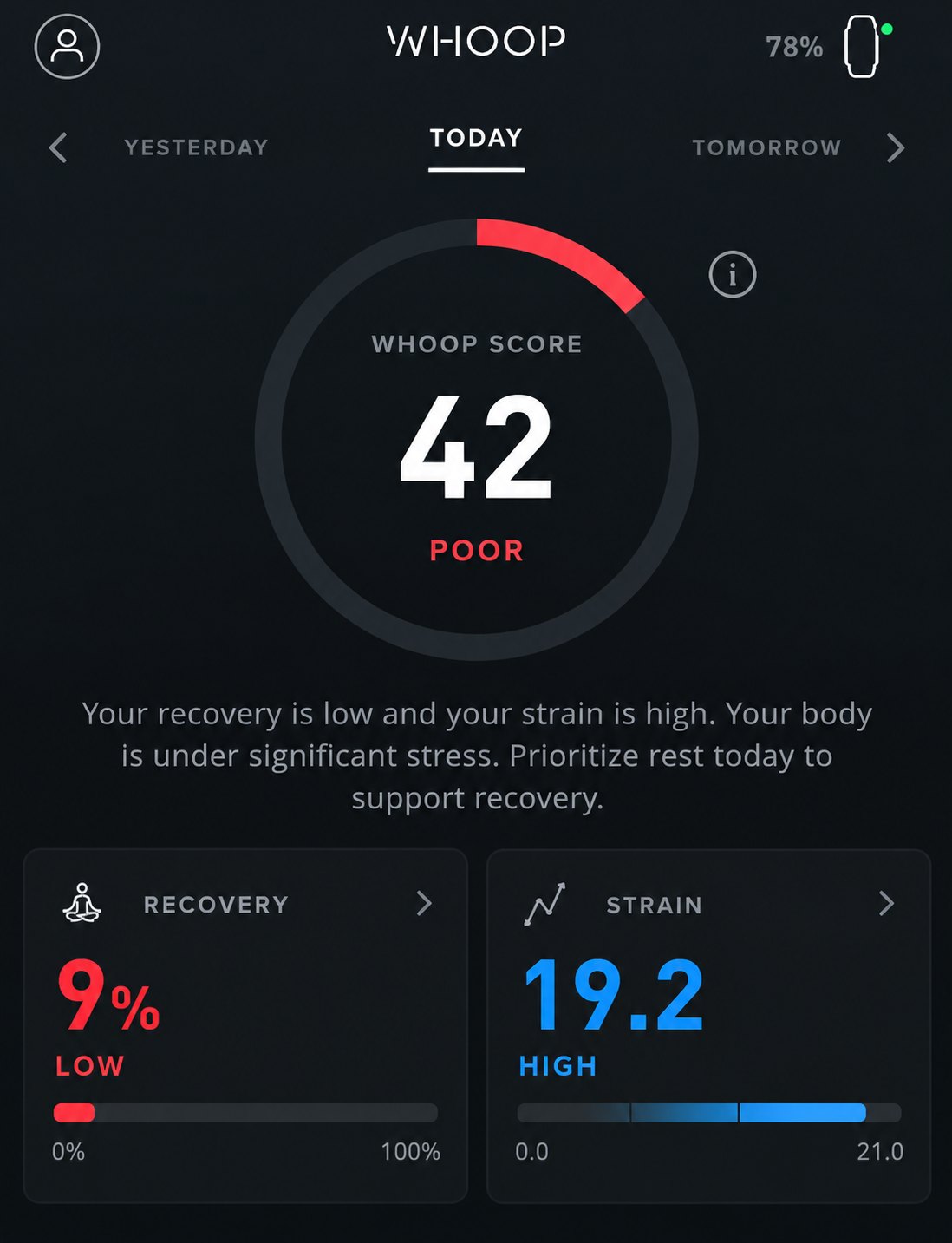
The number appeared on your wrist before you got out of bed. Twenty-three out of a hundred. Body Battery at fourteen percent. Recovery score in the red. The watch has assessed your sleep, your heart rate variability, your resting heart rate, and your respiratory rate, and it has reached a verdict: today is not a training day.
So you did not train. And you have done this before, more than once. There have been sessions you have skipped, intensity you have reduced, and plans you have altered because a device on your wrist told you your body was not ready.
chat
The question worth asking is: what does that number actually measure, what can it tell you, and what is outside its ability to know?
Heart rate variability is the underlying metric that most recovery scores are built on. It measures the variation in time between consecutive heartbeats. A higher HRV generally indicates a more adaptive autonomic nervous system, which correlates with better physical readiness. A lower HRV can indicate accumulated fatigue, illness, high stress, poor sleep, or alcohol in the system. The science behind HRV is real and well-established in sports science research.
What your watch does is combine HRV with sleep duration and quality, resting heart rate trends, and sometimes respiratory rate or skin temperature to produce a single readiness number. That number is then compared against your personal baseline, which the device builds up over weeks of data.
This is real and useful information. An athlete who consistently sees declining HRV trends over two to three weeks is probably accumulating fatigue faster than they are recovering. Someone whose score drops sharply after a night of poor sleep or elevated resting heart rate following illness is getting real signal from a real physiological state.
The problem is not the measurement. The problem is the way many people have started using it.
Recovery scores are population-level tools presented as individual-level instructions. The algorithms that turn HRV data into a readiness score were built on large populations of users. They identify patterns that are true on average. They were not calibrated to your specific physiology, your training history, your goals, or what you actually need from today's session.
Athletes regularly report their best training days following low readiness scores, and their worst training days following high ones. The score captures one dimension of physical state. It cannot account for your motivation, your mood, the type of session planned, what you have been doing outside the gym, or the cumulative importance of showing up on days that feel difficult.
There is also a consistency problem that rarely gets discussed. Long-term training adaptations are built on regular stimulus. The body adapts to what it is consistently asked to do. A training programme that is regularly interrupted because a watch said the readiness was low accumulates gaps in the stimulus that compound over months. The person who trains three days a week regardless of their score, across a full year, will almost always make better progress than the person who trains when the watch approves.
The more useful way to think about recovery scores is as one data point among several, not as a verdict.
If your score is low and you feel thoroughly exhausted, your joints are aching, your motivation is non-existent, and you have been training hard all week, that combination of signals is meaningful. The watch is confirming what your body is already telling you. A rest day or a light session probably is the right call.
If your score is low but you slept reasonably well, you feel alert, and the only reason you are questioning whether to train is the number on your wrist, that is a different situation. Training through a low score in those circumstances is appropriate and often produces sessions that feel and perform better than expected.
The signals worth listening to are the ones your body generates directly: persistent joint pain in specific structures, declining performance across multiple consecutive sessions, disrupted sleep that you notice subjectively, poor appetite, and the general sense of physical depletion that actual overtraining produces. These are not subtle. When the body actually needs rest, it is usually not a mystery. The watch may be pointing at the same thing, but it should be corroborating your own read, not replacing it.
There is a broader point worth making here about wearable technology and how it has changed the way some people relate to their own bodies.
The appeal of a recovery score is that it removes uncertainty. Training feels like a high-stakes decision, and having an objective number makes it feel more manageable. But the uncertainty was never actually the problem. Learning to read your own physical state, to distinguish between the tiredness that needs rest and the tiredness that lifts once you start moving, is a skill that improves with experience. Every time a score makes that decision for you, the skill gets less practice.
Use the data. It is not useless. Long-term HRV trends are worth monitoring. Consistent patterns are worth acting on. But the watch does not know what you are training for, why today's session matters, or what skipping it costs you in terms of habit and momentum. You do.
The score is information. You are the coach.
Book a free No Sweat Intro at priority6.co.uk to talk through what that looks like for you specifically. Click here
Priority 6 | Abingdon's longest-standing independent gym | Crossfit, Weight Loss, Fat Loss, Strength, Performance, Longevity www.priority6.co.uk | @priority6 | ollie@priority6.co.uk
About the Author
Ollie Campbell is a British strength and conditioning coach, specialist fat loss coach, author of Build The Chain, nutrition coach, and founder of Priority 6 in Abingdon, Oxfordshire.