Related

It's Time to Have Something to Train For... Hyrox Might Just Be It!
You train three or four times a week. You have been doing it for years. You are consistent, you work hard, and you are in better shape than most people you know.
But when someone asks what you are training for, you pause. Because the honest answer is that you are not entirely sure. Fitness. Health. To feel better. To keep up with the kids. All of it is true. None of it is specific enough to change how you train on a Tuesday morning when you do not really feel like it.
There is a difference between training and training for something. Between going to the gym because it is on the schedule and going because there is a date circled on the calendar that is going to test you in a very particular way. Most people who have trained consistently for years have never felt that second version.
Hyrox is the most accessible way to feel it.
What Hyrox Is.
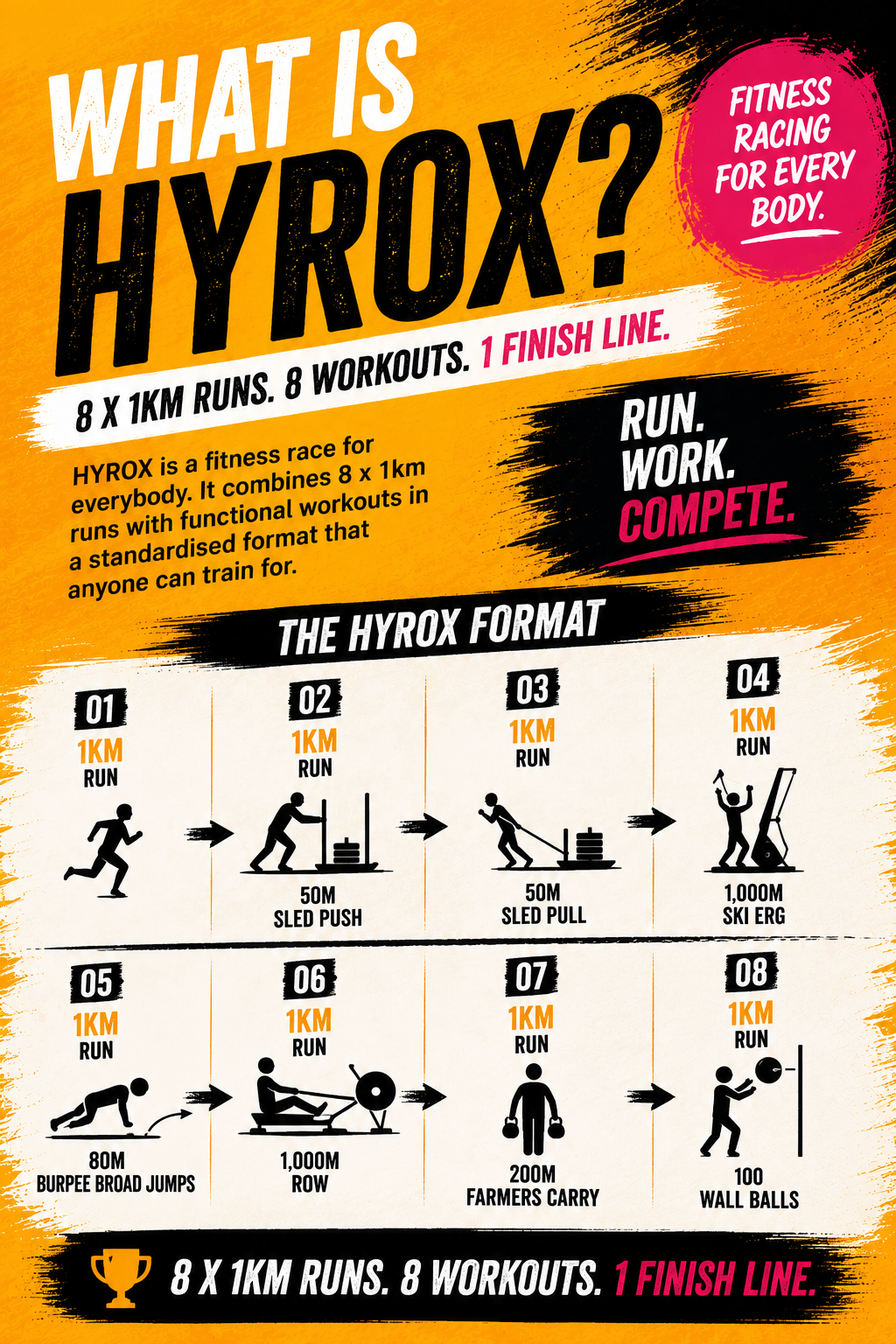
Hyrox is a global fitness race held in major venues across the UK and around the world. ExCeL London, Manchester Central, Edinburgh. Standardised worldwide, which means your finish time from a race in Birmingham is directly comparable to a race in Hamburg or Chicago.
The format is this. You run one kilometre, complete a workout station, then run another kilometre, then another station. Eight times.
The eight stations, in order, are a thousand metre SkiErg, a fifty metre sled push, a fifty metre sled pull, eighty metres of burpee broad jumps, a thousand metre row, two hundred metres of farmers carry, one hundred metres of sandbag lunges, and seventy-five to one hundred wall balls depending on the category you enter.
That is eight kilometres of running and eight workout stations. No barbell in the traditional sense. No technical Olympic lifts. No movements that require months of coaching before you can attempt them. The stations are heavy and accumulate fatigue, and managing that fatigue over the course of the race is the skill the event teaches.
You can enter as an individual, as a same-sex or mixed doubles pair where the work is split between you, or as a four-person relay. There are age categories. You will not be competing against people half your age who train twice a day. You will be measured against people at a comparable stage of life, with comparable histories and demands outside of the gym.
Why This Combination Works.
The format is not accidental.
Running and functional strength work are the two things most gym-goers do in some form but rarely combine in a way that reflects how one affects the other. The person who lifts consistently but does not run will discover their aerobic ceiling somewhere around the fourth or fifth kilometre. The person who runs but rarely lifts will feel the sled push and the farmers carry in ways they did not anticipate.
Neither of those experiences is a problem. They are information. Specific, useful information about where the training has been leaving gaps.
This matters more for people in their 40s than it does for people in their 20s. The qualities that keep you fit, strong, and capable over the long term are aerobic capacity and muscular strength, working together, under fatigue. Not one in isolation. Most gym programmes address one side of that well and the other inconsistently. Hyrox forces you to develop both, within a single preparation block, with a real deadline pressing on every session.
The training you do in the twelve or sixteen weeks before a Hyrox is exactly the training most people in this demographic should be doing with their time. Not because it is the latest thing, but because the physiological demands of the event map almost perfectly onto the demands of a long, healthy, capable life.
What the Training Actually Looks Like.
You do not need to tear up your programme.
If you are already training three or four days a week, a Hyrox preparation block works on top of what you have. You add running if it is not there already, typically two or three sessions a week that build progressively over the twelve to sixteen weeks. You learn to pace the SkiErg and the rowing machine at a sustainable effort rather than going hard from the start. You practice the farmers carry and sandbag lunges when your legs are already working, not fresh at the start of a session.
That last point is the one most people underestimate. The station work in a Hyrox does not happen when you are fresh. It happens after multiple kilometres of running. Practising each movement in isolation, when you feel good, gives you almost no information about how it will feel in the race. The preparation that actually transfers is the work done under accumulated fatigue.
By race week you will have a running base you did not have before, a clear sense of what you can sustain aerobically, and a much better understanding of your actual fitness ceiling. That knowledge does not disappear when the race is over.
You Do Not Need to Feel Ready First.
The most common hesitation is some version of not being fit enough yet.
The running needs sorting out first. The conditioning is not quite where it should be. There are a few more months of prep needed before committing.
That logic sounds reasonable. It also guarantees you never enter.
The fitness comes from having the goal, not from waiting until you feel capable of achieving it. Booking the event is what makes the preparation real. Without a date, it stays intention. With a date, it becomes a training plan.
Every person who has prepared for Hyrox will say the same thing: the week they entered was the week their training changed. The sessions became purposeful. The effort went up. The gaps got addressed. That does not happen through willpower. It happens through having a specific reason to close them.
The community at a Hyrox event is worth mentioning too. A major race is unlike anything most gym-goers have experienced. Thousands of people, full production, a finish line with something real behind it. Most people who cross it are already thinking about the next one before they have recovered their breath.
The One Thing to Do Today.
Search for Hyrox UK events. Find one that gives you at least twelve weeks to prepare. Enter it.
The training plan comes second. The race comes first.
Once it is in the diary, every session has a point it did not have before.
About the Author
Ollie Campbell is a British strength and conditioning coach, specialist fat loss coach, author of Build The Chain, nutrition coach, and founder of Priority 6 in Abingdon, Oxfordshire.
Book a free No Sweat Intro at priority6.co.uk to talk through what that looks like for you specifically. Click here
Priority 6 | Abingdon's longest-standing independent gym | Crossfit, Weight Loss, Fat Loss, Strength, Performance, Longevity www.priority6.co.uk | @priority6 | ollie@priority6.co.uk
.jpg)
.png)
.png)

.png)
.png)