Related

Nike Built a Shoe for HYROX. Here Is What Will Actually Improve Your Time.
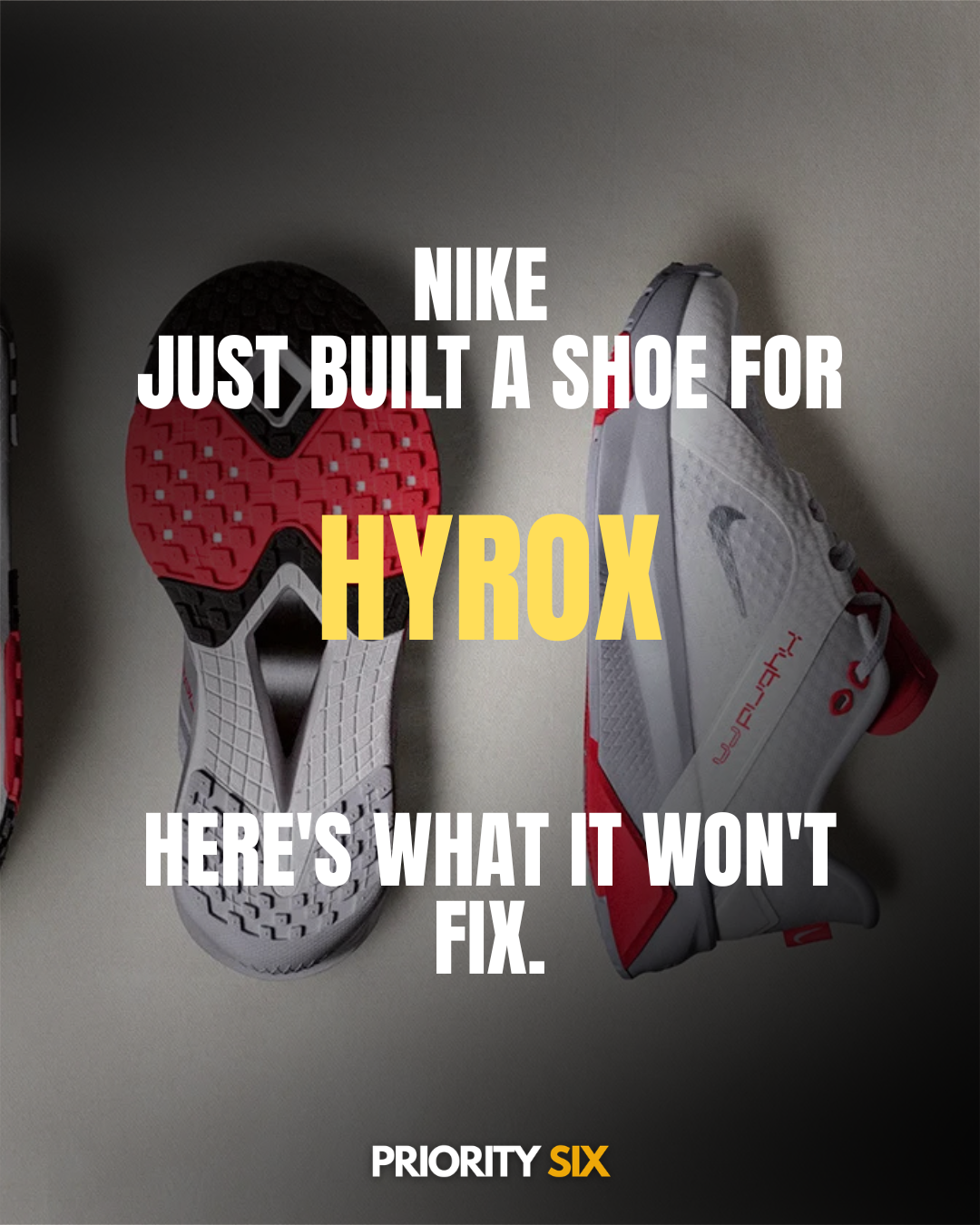
Nike has launched a purpose-built HYROX shoe, the Nike Hybrid, and the coverage of it has been considerable. A major sportswear brand building a shoe specifically for hybrid racing is a signal worth paying attention to. It means HYROX has moved from a niche race for functional fitness enthusiasts into a category that a company with Nike's market research budget thinks is worth building dedicated product around.
That is worth noting. The shoe is also, by most accounts, a good product. But here is what the Nike launch will not change: the four things that actually determine most amateur HYROX finish times. None of them involve footwear.
The Aerobic Engine Problem
Most people who compete in HYROX for the first time make the same error. They are fit enough to run the first two or three kilometres feeling good, and they do. They run at a pace that feels comfortable given their training. Then they arrive at a station with tired legs, push through it, and start the next run section feeling significantly worse than the first.
By station five or six, the run splits are two or three minutes slower than the opening split. The stations are taking much longer because the legs have nothing left for the kind of sustained drive the sled or burpee broad jumps require. The finish time is not a reflection of their overall fitness. It is a reflection of their pacing strategy and the aerobic capacity that underpins it.
HYROX is an event lasting between 60 and 90 minutes for most recreational athletes. It requires the ability to sustain effort across that entire window, not sprint the first twenty minutes. Building that capacity means regular zone two aerobic work, sustained efforts at 60 to 70 percent of maximum heart rate, done consistently for months. Shoes do not change this.
Running Economy
Most gym-trained athletes are weaker runners than their general fitness would suggest. They have capacity, they have strength, and they train hard. But running economy, the efficiency with which your body converts energy into forward movement, develops specifically through running volume. There is no shortcut.
In HYROX, the eight run sections account for eight kilometres of total running, split between stations. For most amateur competitors, the running split is where the largest amount of time is either lost or saved. A person who can push hard on the stations but runs inefficiently will be slower than a person of equal fitness who runs well.
The fix is simple and unsexy. Run more. Three shorter runs per week, building volume gradually over a twelve-week prep, will improve your HYROX time more than any shoe change. The shoe helps at the margins of an already-efficient runner. For someone with underdeveloped running economy, the margins are not the problem.
The Strength Under Fatigue Problem
The HYROX stations are not a test of maximum strength. The sled push weight, the lunges, the burpee broad jumps: these are movements that most regular gym-goers can complete without difficulty when fresh. The challenge is completing them at minute fifty of an event when the aerobic system is already taxed.
Strength under fatigue is a specific quality, and it develops through specific training. Programming sessions that combine aerobic work with station-specific exercises, where you arrive at the station already tired, is what builds this capacity. Most people do not train this way. They run and lift in separate sessions, in separate states of freshness, and then wonder why the lunges feel impossible when their heart rate is at 160.
This is a programming question, not an equipment question.
So... What Does The Shoe Actually Do?
In the interest of being fair: the Nike Hybrid is solving a real problem.
Before purpose-built hybrid shoes existed, HYROX athletes were compromising. Running shoes provided cushioning and efficiency but were poor for sled work, where a flat, grippy outsole and a stable platform for drive angle matters considerably. Cross-trainers handled the stations adequately but were not built for eight kilometres of running. Athletes were either switching footwear or accepting the compromise.
The Nike Hybrid addresses this. A shoe that performs across both the run sections and the stations, with a sole designed to generate traction during sled push without sacrificing too much running efficiency, is a legitimate improvement over the compromise. For an athlete who has already solved the engine, the running economy, and the strength-under-fatigue problem, the shoe is a real edge.
For most amateur HYROX athletes, those problems are not yet solved. And until they are, the shoe is a meaningful investment in the wrong order.
If you are competing in HYROX in the next twelve weeks, the most useful thing you can do this week is not buy the shoe. It is to look honestly at where your time is going.
Are you blowing up on the run sections in the second half? That is an engine problem. Are your run splits slow relative to your fitness? That is a running economy problem. Are the stations getting harder as the event goes on, not because you are not strong enough but because you have nothing left? That is a strength-under-fatigue problem.
All three are solvable through programming. Come and find us at Priority 6 and we can talk through what that looks like specifically for you.
Book a free No Sweat Intro at priority6.co.uk to talk through what that looks like for you specifically. Click here
Priority 6 | Abingdon's longest-standing independent gym | Crossfit, Weight Loss, Fat Loss, Strength, Performance, Longevity www.priority6.co.uk | @priority6 | ollie@priority6.co.uk
About the Author
Ollie Campbell is a British strength and conditioning coach, specialist fat loss coach, author of Build The Chain, nutrition coach, and founder of Priority 6 in Abingdon, Oxfordshire.
.png)
.png)

.png)
.png)
.png)