Related

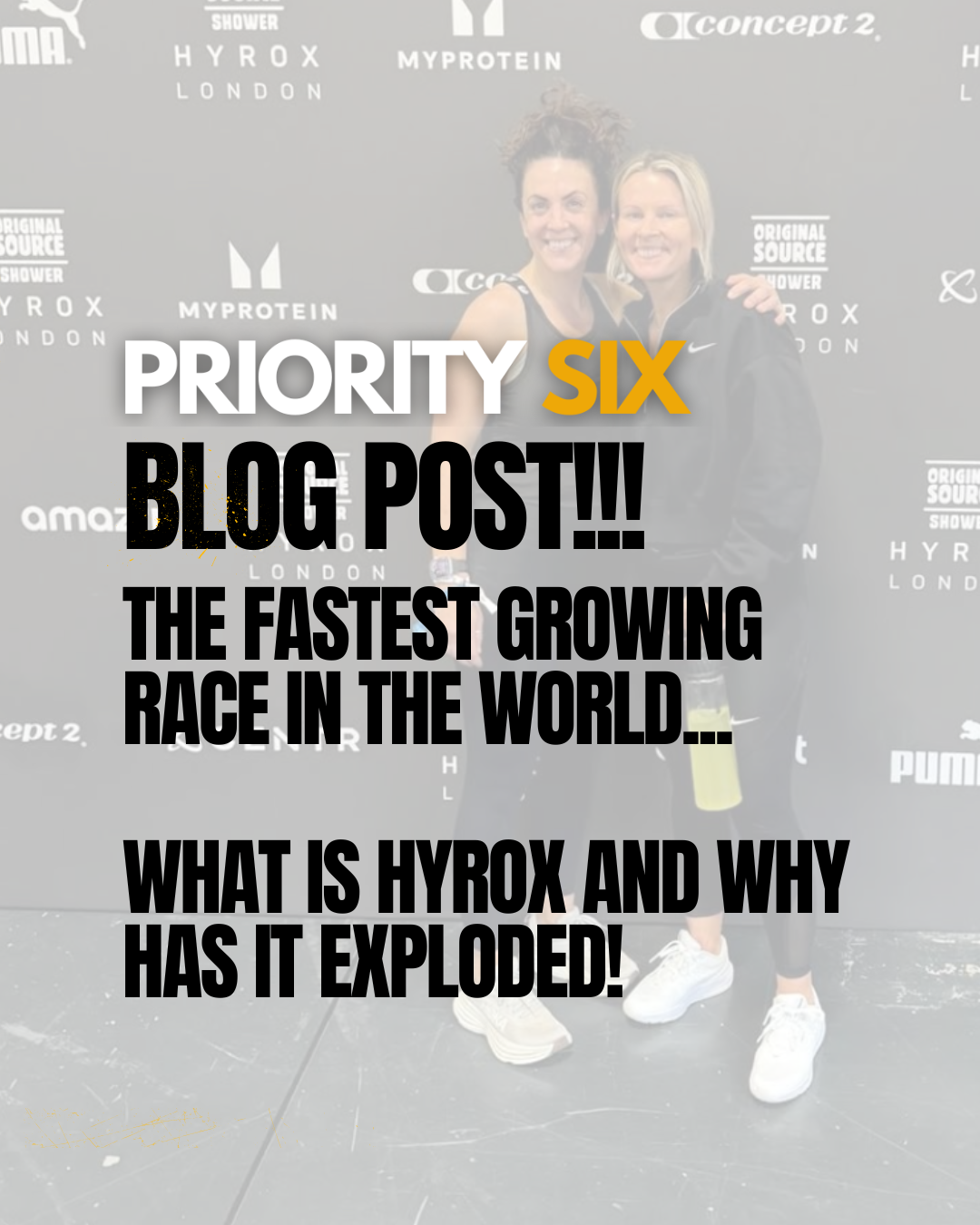
Why Hyrox Has Taken Over as the World's Fastest-Growing Fitness Sport (And What That Means for You)
If you've been in a gym in the last two years, you've heard the word… Hyrox.
It's on kit bags, Instagram feeds, in gym conversations and on training plans. And if you're not sure what it is yet, you're about to understand why the entire fitness industry is paying attention.
Let's look at what's actually happened here, because the numbers are remarkable.
The Growth Story
Hyrox was founded in Hamburg, Germany, in 2017. The first event attracted 650 athletes. Last year, over 650,000 competitors raced worldwide. The 2025 to 2026 season is projecting over one million participants.
London now operates a ballot system, with more than 70,000 people competing for 16,000 race spots. New York's 2026 event spans eight days and 50,000 athletes across two weekends. Over 5,000 gyms worldwide are now official Hyrox training centres, including more than 350 in the UK alone.
That is not a trend. That is a structural shift in how people engage with fitness.
For context: CrossFit, at its peak around 2019, had approximately 15,000 affiliates globally, built over fifteen years. Hyrox has created a comparable worldwide infrastructure in under a decade, and it's still accelerating.
So the question worth asking is: why?
What Hyrox Actually Is
For anyone not yet familiar, the format is simple.
You run one kilometre.
You complete one functional workout station.
You repeat that sequence eight times.
Total distance covered is eight kilometres of running plus all eight stations, completed in one continuous timed effort with no built-in rest.
The eight stations are:
Ski Erg
Sled Push
Sled Pull
Burpee Broad Jumps
Rowing
Farmers Carry
Sandbag Lunges
Wall Balls.
The average finish time sits between 60 and 100 minutes for most recreational athletes. Over 98 percent of people who start a Hyrox event finish it.
Your time is globally comparable. Do a Hyrox in London and your result sits in the same database as someone who raced in Tokyo or Chicago. That standardisation is central to why it works.
Why Hyrox Grew Where CrossFit Plateaued
This is the more interesting question. CrossFit was the dominant force in functional fitness for over a decade. At its peak it was the fastest-growing fitness brand in the world. So what changed?
It comes down to four things.
1. The barrier to entry
CrossFit has a genuine skill problem. To compete meaningfully, you need to be proficient in Olympic lifting, gymnastics movements, and high-skill barbell work. Bar muscle-ups. Snatches. Handstand push-ups. These take years to develop safely and proficiently. Many people tried CrossFit, loved the culture and intensity, but hit a ceiling where progressing felt either technically overwhelming or injury-prone.
Hyrox solved this deliberately.
The eight stations use what are called "natural movements." Pushing a sled, pulling a sled, carrying a weight, lunging with a sandbag. Nobody needs to be coached through a clean and jerk before they can compete. A person who has been training in a gym for six months can turn up to a Hyrox event and complete it. That accessibility opened the sport to millions of people who would never have entered a CrossFit competition.
2. The running component
CrossFit's relationship with running has always been um… complicated. Short sprint intervals appear in workouts, but pure aerobic capacity and sustained running are not at the core of how most CrossFit athletes train. This meant that a huge population of people who run regularly, whether casually or at a club level, had no natural entry point into the CrossFit world.
Hyrox bridges the gap.
Eight kilometres of running is genuinely demanding. It rewards aerobic fitness. Runners who have been wanting to add strength training suddenly have a race that makes that combination meaningful. Gym-based athletes who want to test their cardiovascular fitness in competition have a format designed for them. The overlap between those two populations is enormous.
3. The event experience
CrossFit competitions, particularly at the local affiliate level, are notoriously difficult to spectate. The movements are complex, the scoring is opaque to outsiders, and the atmosphere varies wildly from gym to gym.
Hyrox engineered the event experience from the ground up with spectator appeal in mind.
DJ sets, clear visual format, shared start waves so a slower athlete can cross the finish line at the same time as a faster one, patches on kit bags instead of medals. Every detail was considered for visibility and shareability. The sport was designed to go viral, and it did.
4. The community model
CrossFit built community inside individual affiliate gyms. Powerful within each box, but fragmented across the wider world. Your community was your gym.
Hyrox built community around the race itself.
The event is the focal point. This means that a Hyrox athlete's community extends far beyond wherever they train. They belong to a global competitive format with a shared language, a shared finish line, and a shared leaderboard. That network effect is far more scalable.
What the Hyrox Athlete Actually Looks Like
One of the more revealing statistics: around two thirds of Hyrox competitors are aged 30 and above. The oldest finisher to date is 74. Roughly 38 percent of competitors are female, up from 24 percent in 2020.
This is not a sport for twenty-two-year-old former university athletes. It is a sport for the motivated adult who takes their training seriously, wants a tangible goal to work towards, and is looking for a community that extends beyond the walls of one gym.
That description maps almost exactly onto the P6 member and that’s why we were one of the furst Hyrox Affiliates in the UK years ago, before the format even became famous and why we set up our Hyrox Oxford Instagram
How to Train for Hyrox Intelligently
Here is where most people get it wrong. They see the format, fixate on the running, and spend the months before their race grinding out kilometres at the expense of everything else. Then they get to the sled push on race day and their legs have nothing left.
Hyrox is a hybrid sport. It rewards athletes who have built both qualities: aerobic capacity and muscular strength. Neglecting either is a race strategy that ends badly.
The foundations of smart Hyrox preparation look like this.
Build your aerobic base first. You cannot fake eight kilometres of running under fatigue. If your current comfortable running distance is three to four kilometres, you need time on your feet before you can race effectively. Zone 2 cardio work, runs at a genuinely conversational pace, builds the aerobic infrastructure that lets you sustain pace across the full course.
Train the stations as strength work, not just race simulation. Sled pushes, farmers carries, sandbag lunges. These are loaded movements that should be programmed like strength training, not just practised as cardio. Build capacity in them progressively over months, not weeks.
Practice the transitions. The most underestimated skill in Hyrox is the ability to go from a one-kilometre run directly into a station without falling apart. Train this deliberately. End your running intervals with a station movement. Learn to manage your breathing under load when your heart rate is already elevated.
Don't neglect the Wall Balls. Station eight. You are already eight kilometres of running and seven functional stations deep when you hit it. One hundred wall balls, or more depending on your division. It is the last thing standing between you and the finish line, and athletes consistently underestimate how much it demands when everything else has already been spent.
Manage your weekly structure. A well-built Hyrox training block includes two to three strength sessions, two aerobic development runs, one longer run, and at least one station-specific session. That structure needs to be progressive across a twelve to sixteen week preparation period, not thrown together in the final month.
What P6 Offers Hyrox Enthusiasts…
Priority Six has been coaching hybrid members for years. Our programming integrates strength and conditioning in a way that directly transfers to Hyrox preparation, whether you're approaching your first Open race or targeting a podium position in Pro.
We don't treat Hyrox as a separate specialism bolted onto what we already do, it's part of our culture. The foundations of our training, compound strength work, aerobic conditioning, functional movement, and progressive overload, are the exact foundations a Hyrox athlete needs and then we have those Pryrox classes on our timetable ready for you to surround yourself with other Hyrox junkies.
If you're preparing for your first event, we'll build you a plan that gets you to the start line confident and to the finish line strong. If you're experienced and looking to improve your time, we'll identify the gaps in your performance profile and address them directly.
The sport rewards athletes who train smart over a long period. That's exactly the kind of coaching we exist to provide.
Hyrox grew from 650 athletes to a projected one million participants in under a decade. It did that by solving a genuine problem: millions of people were training in gyms every day with nothing to compete in. Hyrox gave fitness a finish line.
If you've been looking for something to aim at, a goal that demands both strength and endurance and puts your training in a context that actually means something, this is the most accessible and fastest-growing competitive format in the sport right now.
Come and talk to us about how to prepare properly.
Book a No Sweat Intro at
https://www.priority6.co.uk/contact-priority-6-in-abingdon-uk
Priority Six | Abingdon's longest-standing Hybrid gym | Strength, Performance, Longevity, Transformation www.priority6.co.uk | @priority6 | ollie@priority6.co.uk
.jpg)
.png)
.png)
.png)
.png)