Related

You're Still Getting Half the Protein You Need... Please Take This On Board!
I asked a member to track her food for two weeks recently.
She had been training consistently for over a year. Good attendance, solid effort, no obvious issues. But her body composition had barely shifted despite nine months of genuine commitment.
When we looked at the data, one number stood out above everything else. She was averaging 54 grams of protein per day. Her target, based on her bodyweight and goals, was 112 grams.
She was eating less than half what her body needed to recover, retain muscle, and change shape. And she had no idea.
This is not unusual. It is probably the most common nutritional gap we see when we sit down with members and go through the numbers properly. Not a lack of effort. Not the wrong training programme. A protein intake so far below target that progress was structurally impossible.
What Protein Actually Does
Protein is the only macronutrient your body uses to build and repair tissue. Every session creates microscopic damage to muscle fibres. That damage is the stimulus for adaptation. But adaptation only happens if you give your body the raw material to rebuild.
Think of it as bricks. Training tears down the wall. Protein is what the body uses to build it back, slightly stronger than before. Without enough of it coming in, the wall does not get rebuilt. You train hard, recover slowly, feel hungry more often, and make far less progress than your effort deserves.
There is more. Protein has the highest thermic effect of any macronutrient, meaning your body burns more calories digesting it than it does digesting fat or carbohydrates. It is also the most satiating macro. If you finish a meal feeling full but find yourself hungry again within two hours, the most likely cause is that the meal was low in protein. Fullness and satiety are different things. Fullness is the immediate sensation of a full stomach. Satiety is how long that lasts before hunger returns. Protein drives satiety far more effectively than carbohydrate or fat. Adding a meaningful protein source to each meal, without changing anything else, typically extends the time between hunger signals noticeably.
If your goal is to look better, perform better, recover faster, or stay strong into your 50s and beyond, protein is where the conversation has to start.
What You Actually Need
The UK government's recommended daily allowance for protein is 0.75 grams per kilogram of bodyweight. That number exists to prevent deficiency in sedentary adults. It was not designed for people who train.
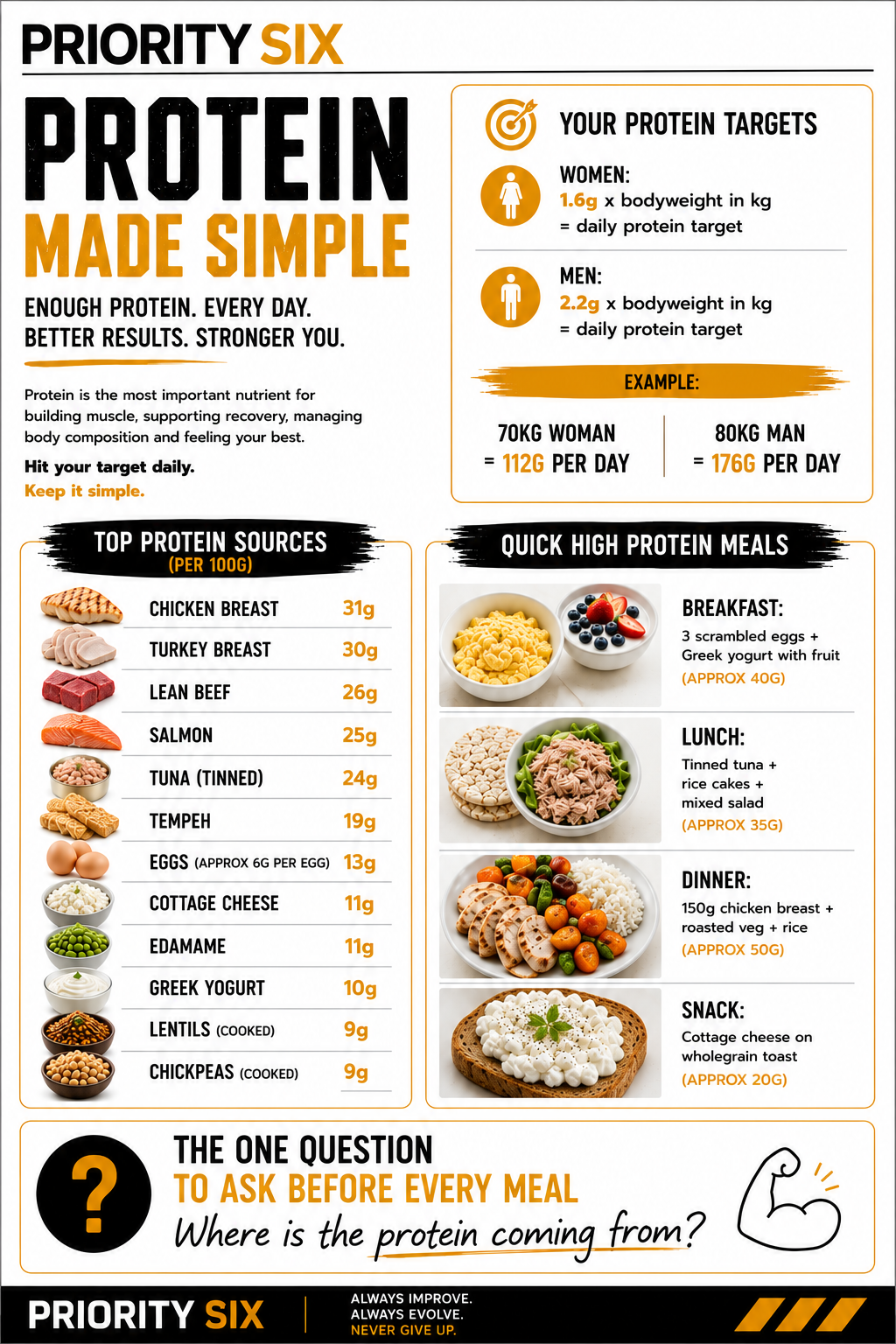
At Priority 6 we use targets based on the research. For women, 1.6 grams per kilogram of bodyweight per day. For men, 2.2 grams per kilogram of bodyweight per day. A 70kg woman needs approximately 112 grams. An 80kg man needs approximately 176 grams.
Most people tracking for the first time are hitting 60 to 80 grams. Sometimes less.
That gap is not a minor rounding error. It is the difference between recovering well and recovering poorly. Between retaining muscle on a calorie deficit and losing it. Between feeling satisfied after meals and spending the afternoon searching for something to eat.
Spread It Across the Day
Your body can utilise roughly 35 to 40 grams of protein per meal for muscle protein synthesis. Hitting your daily target across one or two large meals is significantly less effective than spreading it across three or four.
Every meal should contain a meaningful protein source. Not as an afterthought. As the anchor around which everything else is built.
This is where breakfast matters more than most people realise. If you skip it or eat something carbohydrate-heavy in the morning, you are starting the day behind your target and trying to catch up by evening. That pattern is one of the most reliable causes of afternoon hunger, low energy, and end-of-day frustration with your results.
The Lunch Problem
This is where protein intake most commonly falls apart. A meal deal sandwich contains roughly 15 to 20 grams of protein. A supermarket salad without added protein is often below 10. Manufacturers keep portions of the expensive ingredients small. The cost of that decision is yours to carry, not theirs.
Building a higher protein lunch does not require cooking. Greek yogurt with fruit. Tinned tuna with rice cakes. Pre-cooked chicken with a bag of salad. Cottage cheese on wholegrain toast. None of these are complicated. They require knowing what you are looking for and making sure it is there.
A Word on Protein Powder
Protein powder is food. It is a convenient, cost-effective way to hit your target when whole food sources are not practical. It is not a steroid or a supplement shortcut. It is protein in a portable format.
A whey shake contains roughly 25 grams of protein per serving. A pea and rice blend is the best plant-based option. If you are consistently hitting your target from whole food, you do not need one. If you are not, it is a sensible and effective tool. The goal is the target. How you reach it is secondary.
On the Kidney Concern
You may have heard that high protein diets are hard on the kidneys. This concern comes from research on people who already had kidney disease, in whom high protein intake can be problematic. In healthy adults with normal kidney function, the evidence consistently shows that high protein diets are safe. Multiple large-scale reviews have confirmed this. If you have existing kidney disease, speak to your GP. If you do not, eating to the targets above is well within the ranges studied extensively in the research.
The One Thing to Do
Targets are a guide, not a law. Some days you will hit your number. Some days you will not. The goal is to average close to your target across the week, not to hit it precisely every single day.
What matters most is building the habit of asking one question before every meal: where the protein is coming from.
Work out your daily target using the formula above. Then, for two days, write down what you eat and estimate your protein intake. Do not change anything yet. Find out where you are. That gap is your starting point.
That question, repeated consistently, will shift your intake more than any meal plan ever will.
Don't forget to check out our socials weekly, if you are interested in changing your body and mindset, we only put out relevant, useful and actionable info, that you can use to lead a better life!
Team P6
About the Author
Ollie Campbell is a British strength and conditioning coach, specialist fat loss coach, author of Build The Chain, nutrition coach, and founder of Priority 6 in Abingdon, Oxfordshire.
Book a free No Sweat Intro at priority6.co.uk to talk through what that looks like for you specifically. Click here
Priority 6 | Abingdon's longest-standing independent gym | Crossfit, Weight Loss, Fat Loss, Strength, Performance, Longevity www.priority6.co.uk | @priority6 | ollie@priority6.co.uk
.jpg)
.png)
.png)
.png)
.png)