Related

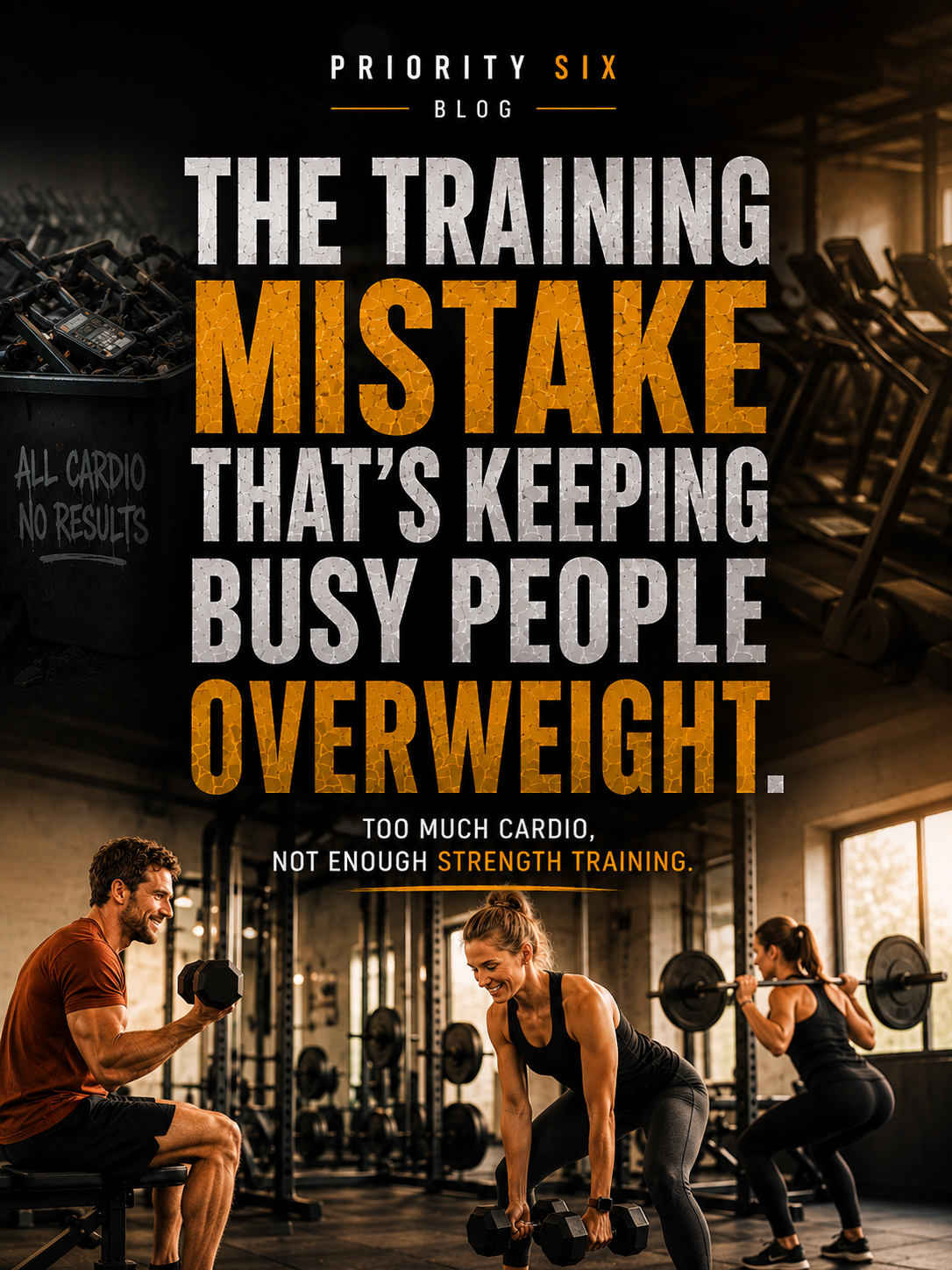
The Training Mistake That's Keeping Busy People Overweight
You have three, maybe four hours a week to train. You use them. You show up, you work hard, and you do the thing that every piece of weight loss advice has told you to do.
You do cardio.
You run, you cycle, you get on the rowing machine and push until it hurts. You burn calories. You feel the effort. And after months of this, your weight has barely shifted.
The problem is not your effort. The problem is the tool.
Most busy people default to cardio when they want to lose weight, and the logic seems sound: cardio burns calories, a calorie deficit causes fat loss, therefore more cardio means more fat loss. Clean, simple, wrong.
Not entirely wrong. But incomplete enough to explain why so many people are working hard and going nowhere.
What Cardio Actually Does
Cardio burns calories during the session. That part is true. A 45-minute run might burn 400 to 500 calories. Visible. Measurable. Satisfying.
But your body is an adaptation machine. Expose it to the same cardiovascular stress repeatedly and it becomes more efficient at producing that output for less energy. Over weeks and months, the same run burns fewer calories than it did when you started. You have to do more to get the same return.
For someone with four hours a week to train, there is no capacity to keep scaling up. The ceiling arrives fast.
There is a second problem worth understanding. Cardio at significant volumes, particularly when combined with a calorie deficit, can accelerate the rate at which your body breaks down muscle tissue for fuel. For someone already time-pressed and under-recovering, this matters. You end up lighter on the scale but with a less metabolically active body than you started with. Normal eating resumes and the weight returns faster than it left.
This is not a reason to avoid cardio entirely. It is a reason to understand what it actually does, and to stop asking it to do something it was never designed for.
What Strength Training Actually Does
This is where the maths changes entirely.
Muscle tissue is metabolically expensive to maintain. Your body burns calories sustaining it around the clock, not just during exercise. Every meaningful gain in muscle mass raises your resting metabolic rate. The effect per kilogram is not enormous, but compounded across a body with significantly more muscle, and maintained permanently, the impact on body composition is substantial.
A strength training session burns fewer calories in the moment than a cardio session of the same duration. But the adaptation it drives, more muscle, a higher resting metabolic rate, improved insulin sensitivity, better hormonal signalling, increases the calories your body burns every hour of every day, whether you are training or sitting at a desk.
For a busy person with three or four hours a week, this is the only approach that keeps working after the session ends.
The research on this is consistent. Studies comparing cardio-only and resistance-only training for body composition in adults over 35 repeatedly find that resistance training produces superior outcomes for fat mass reduction when total training time is matched. Not marginally better. Meaningfully better. And the advantage grows over time as muscle is built and maintained.
The Sweat Illusion
There is a psychological dimension here that deserves to be named directly.
Cardio feels productive. Your heart rate spikes, you sweat, you finish exhausted. The effort is visible and immediate. It maps cleanly onto the intuition that hard work produces results.
Strength training, particularly in the early weeks, can feel deceptively moderate by comparison. You lift something, rest, lift again. The cardiovascular demand is lower. The sweat is often less dramatic.
But perceived effort during a session has almost no relationship to the body composition outcome of that session. What matters is the structural and hormonal response over the hours and days that follow. And on that measure, a well-constructed strength session is not in the same category as steady-state cardio.
The fitness industry has spent decades equating sweat and elevated heart rate with productive training. For people trying to change their body composition with limited time, that association is actively misleading.
What This Looks Like in Practice
This is not an argument against cardio. Cardiovascular fitness matters for health, performance, and longevity. Keep it in your week if you enjoy it or if your goals require it.
But if body composition is the primary objective and your training time is limited, those hours need to be anchored in strength work. Two to three compound strength sessions per week, built around squats, deadlifts, pressing, and pulling, will drive more change to your body composition than the same hours on a treadmill or bike.
The sessions do not need to be long. Thirty to forty minutes of well-structured compound work, done with progressive overload, is enough.
Progressive overload means doing slightly more over time: more weight, more reps, or both. This is the signal your body needs to build and retain muscle. Without it you are maintaining. With it you are building. The difference between those two states is the difference between a metabolism that is slowly working against you and one that is consistently working for you.
What to Do This Week
Replace one cardio session this week with a thirty to forty minute strength session built around compound movements. Squat, hinge, push, pull. Work hard enough that the final two reps of each set are genuinely challenging. Rest long enough to repeat that effort with quality.
Do this for four weeks before drawing any conclusions. Body composition changes from strength training do not show up on the scale in week one. They show up in how your clothes fit, how you look, and eventually on the scale around weeks six to eight as fat is displaced by muscle.
The scale is a poor tool for measuring body composition change. Do not let it determine whether the approach is working.
You have a limited number of training hours each week. Every one of them should do something that does not stop when the session ends.
Book a free No Sweat Intro at priority6.co.uk to talk through what that looks like for you specifically. Click here
Priority 6 | Abingdon's longest-standing independent gym | Crossfit, Weight Loss, Fat Loss, Strength, Performance, Longevity www.priority6.co.uk | @priority6 | ollie@priority6.co.uk
About the Author
Ollie Campbell is a strength and conditioning coach with over 20 years of experience working with everyday athletes aged. He is the founder of Priority 6, Abingdon's longest-standing CrossFit and personal training gym, where he coaches clients to build strength, improve performance, and stay physically capable for decades. His approach is evidence-based, direct, and built around the reality of people with busy lives and high standards. He has no interest in quick fixes or generic advice. Only in what actually works when applied consistently over time. Build The Chain!
.jpg)
.png)
.png)
.png)
.png)