Related

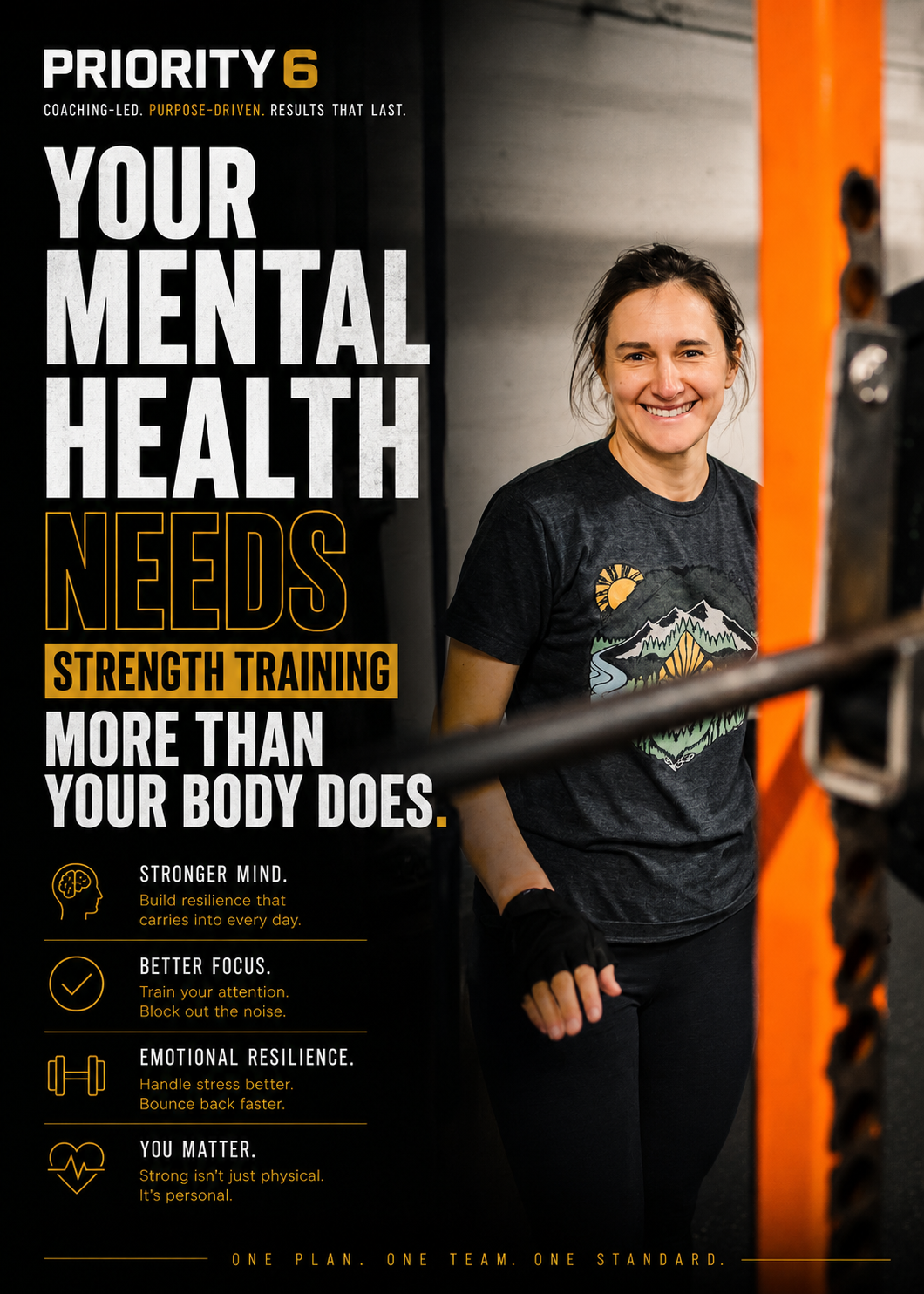
Your Mental Health Needs Strength Training More Than Your Body Does
Most people who start strength training do it for the body.
They want to lose fat, build muscle, look better. These are legitimate goals and there is nothing wrong with them. But ask the people who have been training consistently for three, five, ten years why they still do it, and you will rarely hear the physical reasons listed first.
What you hear instead is something harder to articulate. They sleep better. They handle stress differently. They feel like themselves in a way they struggle to describe. They notice when they miss sessions, not because of guilt about the training, but because something in the way they are moving through the world feels off.
The fitness industry sells strength training as a body transformation tool. It is actually one of the most effective mental health interventions available. And almost nobody says so clearly.
What Training Does to Your Brain
The mechanism most people are aware of is endorphins. Exercise releases endorphins, endorphins make you feel good. That is true and it is also the least interesting part of the story.
What strength training specifically does to the brain goes considerably further.
Resistance training increases the production of BDNF, brain-derived neurotrophic factor. BDNF is essentially a growth protein for the brain. It promotes the creation of new neural connections, supports the survival of existing neurons, and is consistently associated with reduced symptoms of depression and anxiety. Some researchers describe it as fertiliser for the brain. Multiple studies have found that resistance training produces BDNF increases comparable to antidepressant medication in people with mild to moderate depression.
Strength training also directly regulates cortisol, the primary stress hormone. Acute training sessions temporarily raise cortisol, which is normal and appropriate. But consistent training over time reduces baseline cortisol levels. Your body becomes better at managing the stress response, not just during training but throughout the day. The result is a person who is less reactive to stress, recovers from difficult situations faster, and experiences lower background levels of anxiety.
Neither of these mechanisms requires you to feel motivated, enjoy every session, or achieve a particular result. The biology works regardless.
The Self-Efficacy Loop
Beyond the biochemistry, there is something happening psychologically in a consistent training practice that is worth naming directly.
Progressive overload, the principle that underpins effective strength training, means you are regularly and deliberately doing things you could not do before. You lift a weight that felt impossible three months ago. You complete a set of movements that would have floored you at the start of the year. You keep a commitment to yourself, repeatedly, over a long period.
This builds what psychologists call self-efficacy. Not confidence in the generic sense, but a specific, evidence-based belief that you are capable of doing hard things. That you can set out to achieve something and follow through. That your body responds to what you ask of it.
The research on self-efficacy consistently shows it transfers across domains. People who build it in training tend to carry it into work, relationships, and difficult situations in other areas of life. The gym becomes a place where they practise, repeatedly, the experience of attempting something hard and succeeding. That experience does not stay in the gym.
Stress, Identity, and the Reliable Hour
There is a third dimension that tends to get overlooked entirely because it is not biochemical and it is not psychological in a clinical sense. It is structural.
For many people, particularly those in their late thirties and forties managing careers, families, and the accumulating complexity of adult life, the training session is one of the only hours in the week that belongs entirely to them. It is an hour with a clear objective. A place where progress is measurable and feedback is immediate. A space that does not require them to manage anyone else's needs or navigate anyone else's expectations.
This matters more than it sounds. Chronic stress is not just a biological event. It is also the result of repeatedly operating in situations where the demands are unclear, the outcome is unpredictable, and the sense of control is low. The training session is the structural opposite of that. The demands are clear. The outcome is largely within your control. Progress is visible.
People who train consistently are not just managing their stress biochemically. They are spending regular, predictable time in an environment where they experience mastery and control. That changes how they relate to the parts of life where those things are harder to find.
What to Do This Week
This week, go to two training sessions not with the goal of changing your body, but with the intention of noticing what happens to your head.
Notice how you feel in the two or three hours after. Notice how you sleep. Notice whether the difficult conversation you have been avoiding feels slightly more manageable the morning after a hard session.
You do not need to abandon the physical goals. They are still valid and they will still happen. But when the motivation to train runs dry, as it does for everyone eventually, what keeps people coming back is not the pursuit of a body composition target. It is the knowledge of what consistent training does to the way they function.
Start paying attention to that part. It is the reason most people are still training ten years from now.
Sound like something you have been missing?
Book a free No Sweat Intro at priority6.co.uk to talk through what that looks like for you specifically. Click here
Priority 6 | Abingdon's longest-standing independent gym | Crossfit, Weight Loss, Fat Loss, Strength, Performance, Longevity www.priority6.co.uk | @priority6 | ollie@priority6.co.uk
About the Author
Ollie Campbell is a British strength and conditioning coach, specialist fat loss coach, author of Build The Chain, nutrition coach, and founder of Priority 6 in Abingdon, Oxfordshire.
.jpg)
.png)
.png)
.png)
.png)