Related

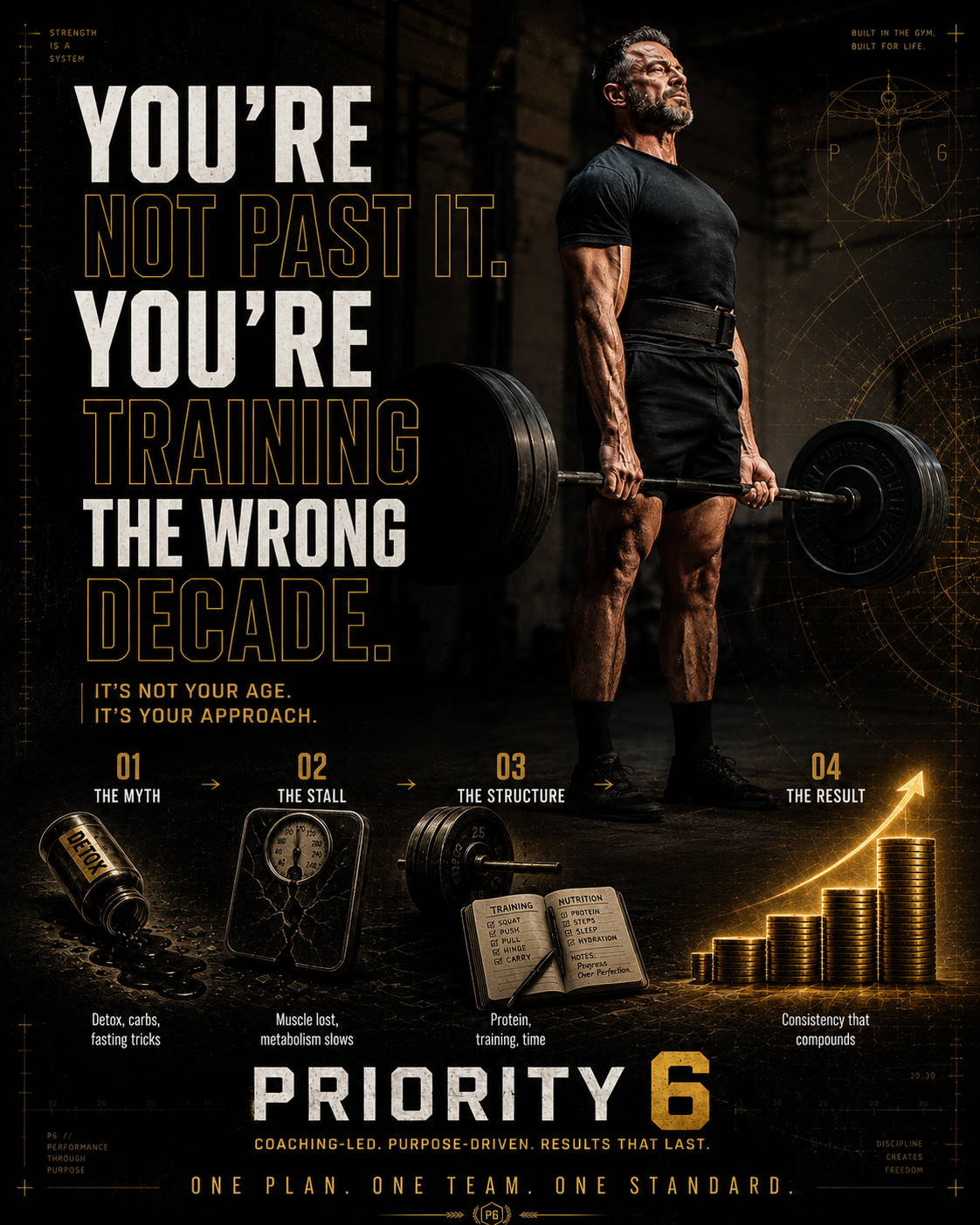
You're Not Past It. You're Training the Wrong Decade.
You trained hard in your twenties. You know what a deadlift is. You know roughly what protein is for.
And somewhere in the last few years, a quiet thought has started turning up after a hard session.
Am I past it now.
Nobody says it out loud. It just sits there, every time recovery takes a day longer than it used to, every time an old niggle complains a bit louder than it should.
That thought is wrong. And believing it is costing you more than almost any other belief in fitness.
The Decline Story Everyone Believes
Most fitness advice aimed at anyone over thirty-five carries the same hidden assumption. Your physical prime already happened, somewhere back in your twenties or early thirties, and everything since is decline management. Hold onto what you've got. Slow the loss. Fight the clock.
That framing is demoralising, and it is also wrong.
Your body does not have one window for building and one long slope downhill after it. It has different priorities at different ages, and the work that actually matters changes shape decade by decade. Train your forties like your twenties, more volume, more frequency, gritting through fatigue you used to shrug off, and you will not get the same return. Not because you have lost it. Because the job changed and the training did not.
Picture two people doing the identical programme, one twenty-eight, one forty-eight. For the younger one, it is mostly topping up something the body already manages well alone. For the older one, those same sessions are now doing a job their hormones used to do for free. Same training. Completely different purpose. Miss that, and you keep training as though the job hasn't changed, then wonder why the results have.
What Is Actually Happening in Your Forties and Fifties
Here is the mechanism, and it matters whether you are a man or a woman reading this.
For women, the mid-forties to mid-fifties typically bring perimenopause and menopause. Oestrogen decline accelerates losses in bone density and muscle mass, and left untrained, those losses can move faster across this one decade than across the two decades before it combined. The training that worked fine in your thirties, moderate weights, steady cardio, is no longer enough. The hormonal environment that used to help protect bone and muscle has changed underneath you.
For men, the equivalent is a slower decline in testosterone alongside an accelerating loss of muscle mass and strength if it isn't actively countered. This loss does not begin in your sixties. It begins quietly in your thirties, and becomes measurable right here.
Muscle is not just an aesthetic feature for either sex. It is what your body relies on for insulin sensitivity, resilience against injury, and staying capable into old age. The training that protects it has an outsized effect in this exact decade, precisely because this is when the natural pressure to lose it is at its highest.
It shows up in ordinary, visible ways long before any test confirms it. Jars that used to open easily start needing two hands. Stairs start asking something of you. Getting up off the floor after playing with a child or grandchild stops being automatic. None of that is ageing in some vague, unavoidable sense. It is muscle and strength quietly going untrained while everything else in life gets the attention.
Why This Makes It Your Highest-Leverage Decade
Here is the part almost nobody says clearly. The decade with the steepest natural pressure working against you is the decade where properly targeted training pays back the most.
Think about it in terms of return, not effort. In your twenties, your body was protecting muscle and bone for you, mostly without help. Train hard or train moderately, the cost of getting it slightly wrong was low. In your forties and fifties, that protection has been withdrawn. Every session of real resistance training is now doing work your hormones used to do for free. That is not a worse trade. It is the best trade available to you, because the alternative, doing nothing differently, has the steepest cost of any decade on the table.
The decade you have quietly written off as your decline decade is, physiologically, the one where the gap between training properly and not training properly is largest. That gap is leverage. You are not past it. You are standing in the decade where training matters most, and treating it like the decade where it matters least.
Leverage like this does not come around often. Usually effort and return move together in a predictable line. Here, for once, the return on doing it properly is disproportionately large, simply because the cost of doing nothing has risen sharply while most people's effort has stayed exactly where it was in their thirties.
What To Do About It
Stop assessing your training by how it compares to your twenties. The comparison that matters is between what your body needs now and what you are actually giving it.
If you are training mainly with light weights, steady cardio, and good intentions, that is the pattern to change first. Resistance training twice a week minimum, with weights heavy enough that the last two reps of your main lift are genuinely hard. Six to ten reps is a sensible range to work within. Add one session a week with something fast in it too, a short sprint, a throw, a jump, because power fades faster than raw strength does and it is just as trainable.
Protein needs the same honesty. Most people in this decade are under their number without realising it. Aim for roughly one point six to two grams per kilogram of bodyweight a day, spread across three or four meals rather than loaded into one.
A few other things earn their place alongside the training itself. If you have not had a blood panel done in a few years, get one, and if you are moving through perimenopause or menopause, have an honest conversation with your GP rather than guessing. Treat sleep as a training variable, not a vague hope, because recovery here is doing more work than it used to. And track two simple things over time, your grip strength and whether you can get up off the floor without using your hands. Neither needs equipment, and both tell you, honestly, which way your trajectory is heading.
The One Thing to Do Today
You now know something most fitness content will not tell you. The decade you assumed was for managing decline is the decade where training has the highest leverage you will ever get.
Before your next session, do one thing. Add weight to your main lift, properly, not recklessly, and hit a real protein number at your very next meal. Not more cardio. Not more sessions. More load, more protein, less apology for training like you mean it.
That is the whole adjustment. Not a new programme. One decision, acted on at your next session.
About the Author
Ollie Campbell is a British strength and conditioning coach, specialist fat loss coach, author of Build The Chain, nutrition coach, and founder of Priority 6 in Abingdon, Oxfordshire.
Book a free No Sweat Intro at priority6.co.uk to talk through what that looks like for you specifically. Click here
Priority 6 | Abingdon's longest-standing independent gym | Crossfit, Weight Loss, Fat Loss, Strength, Performance, Longevity www.priority6.co.uk | @priority6 | ollie@priority6.co.uk
.jpg)
.png)
.png)
.png)
.png)